


Views: 0 Author: Site Editor Publish Time: 2026-06-04 Origin: Site


Handling liquefied petroleum gas presents inherent volatility. Operators constantly face rapid phase changes, high vapor pressures, and strict containment regulations. Any misstep during transfer operations invites severe safety hazards and regulatory fines. Upgrading or installing a new transfer system requires careful planning and engineering precision. Plant managers and engineering procurement teams must balance high-speed unloading requirements with strict zero-emission mandates. They also need to ensure long-term equipment longevity under exceptionally harsh ambient conditions. Relying on outdated liquid transfer methods creates operational bottlenecks and environmental compliance issues.
This article provides a transparent, engineering-focused framework. It helps you thoroughly evaluate, specify, and integrate a high-performance LPG Compressor system for both unloading and vapor recovery operations. You will learn how to completely prevent catastrophic liquid slugging, drastically improve railcar transfer times, and reclaim residual product safely. By adopting these standards, you protect your infrastructure while maximizing your site's operational efficiency.
Efficiency Baseline: Properly sized compressors cut standard railcar/trailer unloading times to 45–60 minutes by utilizing pressure differentials instead of mechanical pumping.
ROI Factor: Vapor recovery modes reclaim the 3% of product typically left behind in conventional liquid transfer, delivering measurable payback.
Risk Mitigation: Catastrophic failure from "liquid slugging" is the highest operational risk; ASME-certified liquid traps and interlocking float switches are mandatory non-negotiables.
System Integration: Naked compressors often fail due to poor station design; fully engineered, ATEX-certified skid packages ensure compliance and operational safety.
You must understand the fundamental physics of gas transfer to optimize your station layout. Traditional pumps move liquid directly through the pipeline. They pull fluid from the bottom of the transport vessel and push it into the receiving storage tank. In contrast, compressors operate using an entirely different thermodynamic principle. They handle only the vapor phase of the product. The machine draws gas from the receiving storage tank and pressurizes it. It then pushes this high-pressure vapor back into the transport vessel. This action creates a strong differential pressure. This pressure naturally pushes the liquid out through the vessel's bottom valves. It moves the fluid smoothly without mechanical agitation.
Propane and butane mixtures possess inherently high vapor pressures. This characteristic causes major problems for traditional liquid pumps. When a pump draws fluid, it creates a slight vacuum at the suction inlet. This localized pressure drop causes the liquid mixture to flash or boil instantly. Bubbles form rapidly inside the pump housing. We refer to this phenomenon as vapor locking or cavitation. As these vapor bubbles reach the higher-pressure discharge side of the pump, they collapse violently. This micro-implosion tears metal away from the impeller. It ruins mechanical seals rapidly. It severely disrupts the flow rate, often causing the entire unloading process to grind to a halt.
A well-calibrated vapor compressor avoids cavitation entirely. Because it never touches the liquid phase, it bypasses the vapor pressure problem altogether. This simple engineering shift enables a highly consistent 45-to-60-minute unloading cycle for standard transport trailers. It effectively doubles the speed of gravity-fed systems. It also vastly outperforms struggling pump configurations that constantly require venting and maintenance.
Standard liquid transfer routines generate hidden financial losses. When operators rely solely on liquid pumps or gravity feeds, they routinely leave behind residual product. Up to 3% of the vessel's total capacity remains trapped inside. This leftover material consists of a shallow puddle of residual liquid and a large volume of highly pressurized vapor. If you disconnect the hoses and send the trailer back to the supplier, you lose this product. You essentially pay for gas that you never get to sell or use. This represents a massive invisible drain on your operational budget.
Vapor recovery systems stop this financial leak by reversing the standard transfer process. Once the liquid transfer finishes, the operator initiates a straightforward recovery sequence.
The operator shifts a simple four-way flow-reversal valve on the piping manifold.
The compressor begins drawing vapor out of the now-empty transport vessel.
This suction rapidly lowers the internal pressure of the supply tank.
The pressure drop can cause part of the remaining liquid to vaporize as conditions change, but it does not guarantee instant vaporization of all residual liquid.
The recovered vapor is compressed and transferred to the designated storage system.
Recovering this 3% yields massive financial impacts. When you multiply this retained volume across hundreds of annual transfer cycles, you achieve an immediate and measurable payback. Furthermore, you gain a distinct dual benefit. By capturing the vapor instead of venting it during hose disconnections, you drastically reduce fugitive emissions. This directly improves your site compliance with strict local and federal environmental regulations.
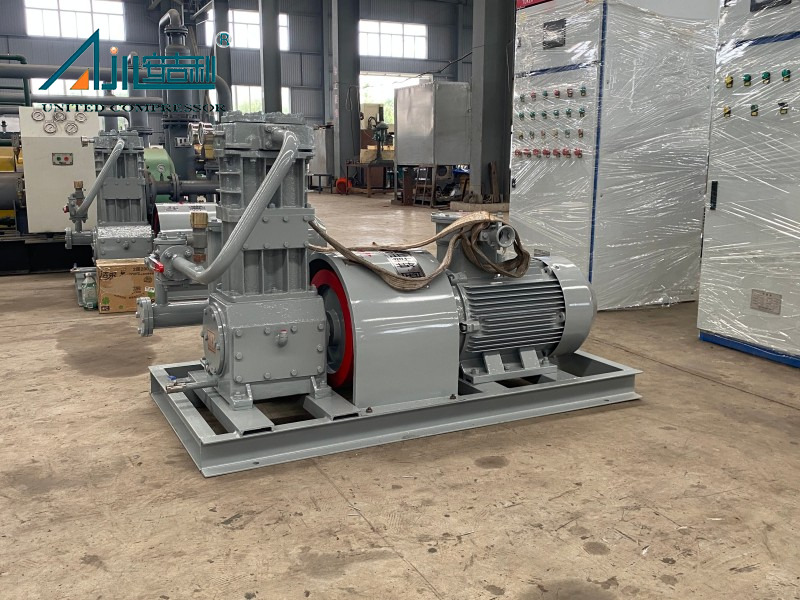
Mechanical isolation serves as your first line of defense against catastrophic accidents. When evaluating equipment, you must demand a crosshead and piston rod packing design. This specific architecture physically isolates the upper compression cylinder from the lower crankcase. Without this isolation, highly flammable gas would bypass the piston and blow down into the lubricating oil. This contamination creates extreme fire hazards and causes dangerous crankcase explosions. The crosshead design ensures that even if cylinder seals wear down, the gas vents safely away from the mechanical drive components.
Positive sealing and containment technologies prevent dangerous fugitive leaks. You should evaluate the necessity of PTFE pressure-assisted piston rings. PTFE offers exceptional self-lubricating properties. These rings expand dynamically under pressure to maintain positive sealing against the cylinder walls. They reduce friction and ensure continuous compression efficiency. Furthermore, you must advise your engineering team against using standard flat gaskets. You should specify advanced O-ring construction instead. O-rings sit perfectly inside machined grooves. They expand and contract fluidly as equipment temperatures fluctuate. This design minimizes fugitive emission risks during extreme thermal cycling.
Material durability remains non-negotiable in hazardous gas applications. You must demand ductile iron cylinders and heads. Do not accept standard cast iron under any circumstances. Ductile iron contains nodular graphite, which allows the metal to flex slightly under stress. It withstands the severe thermal and mechanical shocks inherent in liquefied gas handling. Standard cast iron is brittle and will shatter if subjected to sudden pressure spikes.
You must also clearly understand structural application boundaries. For instance, a Natural Gas Compressor is built primarily to overcome extreme outright pipeline pressures. A Hydrogen Compressor requires specialized metallurgy to prevent hydrogen embrittlement. Meanwhile, a BOG Compressor strictly handles cryogenic boil-off gas at extremely low temperatures. You cannot swap these units indiscriminately. An LPG unit is uniquely engineered to manage dual-phase risks and high vapor pressures at ambient temperatures. This makes it fundamentally distinct from a standard CNG Compressor.
Compressor Type | Primary Application | Core Technical Challenge | Typical Operating Phase |
|---|---|---|---|
LPG Compressor | Propane/Butane unloading and vapor recovery | Managing phase changes and liquid slugging | High vapor pressure, ambient temperatures |
Natural Gas Compressor | Pipeline transport and field gathering | Extreme outright discharge pressures | Dry gas, continuous high pressure |
BOG Compressor | LNG storage boil-off gas management | Extreme temperature gradients | Cryogenic vapor, low temperatures |
Hydrogen Compressor | Refinery processing and fuel cells | Metal embrittlement and molecular leakage | Lightest gas, ultra-high pressure |
Reciprocating gas compressors cannot compress liquids. This remains an absolute objective physical law. Even trace amounts of incompressible fluid entering the cylinder will cause catastrophic mechanical failure. Industry professionals refer to this event as liquid slugging. When the piston travels upward against an incompressible wall of liquid, something must give. It instantly destroys internal valves, bends thick piston rods, and shatters cylinder heads. It presents the highest operational risk to your facility.
You must implement mandatory physical safeguards to prevent this disaster. Every system requires an ASME-certified Liquid Trap installed directly on the suction side of the machine. This trap serves as a heavy-duty physical barrier. You must specify dual-layer protection for these traps.
Mechanical Baffles: Internal metal plates force the incoming gas stream to rapidly change direction. This knocks heavy liquid droplets out of the vapor, allowing them to fall to the bottom of the trap.
Electrical Float Switches: Automated sensors monitor the internal liquid level continuously. If the liquid puddle rises dangerously close to the suction intake, the switch triggers instantly. It immediately cuts motor power and shuts down the system safely.
Station piping and foundational realities also dictate the long-term survival of your equipment. Reciprocating machinery inherently generates cyclic pulsations and vibrations. If you hard-pipe the machine directly to the main station headers, these vibrations travel through the steel. They concentrate at weld joints and rigid elbows. Over time, metal fatigue sets in, causing welds to crack and leak flammable gas. You must address vibration transmission early by mandating flexible piping connections and robust vibration dampening. Furthermore, you must specify deep foundational requirements. Require a minimum 8-inch reinforced concrete pad. Secure the skid using deeply embedded "J" bolts. This solid mass prevents long-term structural fatigue and anchors the kinetic energy safely.
Buying standalone or "naked" equipment invites integration disasters. Station operators require complete, fully aligned systems. Standalone machines lack the necessary peripheral safety controls. They force local contractors to build piping networks from scratch, often leading to crucial design errors. You need precise P&ID (Piping and Instrumentation Diagram) alignment from the factory. You must demand pre-piped manifolds, correctly sized liquid traps, and integrated safety interlocks built directly onto a unified steel base.
Consider real-world deployment challenges when specifying these skids. Middle Eastern climates, for example, routinely hit ambient temperatures of 45°C (113°F). Extreme environmental heat causes severe spikes in LPG vapor pressure. The compressor must work significantly harder to overcome this intense backpressure. Standard air-cooled cylinders will overheat rapidly under these conditions. These environments necessitate custom heat exchangers. Look for Kim Kool-style aftercoolers featuring internal deflector plates. These plates force ambient cooling air aggressively over the finned tubes. Pair them with heavy-duty liquid cooling loops to maintain safe operating temperatures.
Ensure the final skid assembly meets stringent regional compliance requirements. In hazardous gas zones, you must look for ATEX and IECEx certifications. Require NEMA 7 explosion-proof control panels to house all electrical components safely away from explosive vapors. PLC automation plays a critical role here. An advanced PLC safely manages unattended vapor recovery cycles. It continuously monitors float switches, discharge temperatures, and pressure differentials. By automating these routines, you remove human error from the equation and guarantee operational compliance.
Specifying a gas transfer system is ultimately an exercise in risk management and efficiency maximization. You must balance the physical demands of high-pressure vapor with rigorous safety standards to protect your personnel and infrastructure.
We advise buyers to prioritize manufacturers or integrators who provide verified unloading time data rather than mere theoretical capacities. Always demand proven liquid-slugging safeguards like ASME-certified traps. Insist on turnkey skid engineering to eliminate field-installation errors.
Take proactive steps today to secure your site. Consult with a qualified application engineer regarding your specific gas mixture, noting exact propane and butane ratios. Request a custom P&ID review tailored to your site layout to ensure seamless, safe, and highly profitable operations.
A: No. A standard Natural Gas Compressor or air unit lacks the required specific rod packing and chemically compatible O-rings. They cannot safely handle the unique phase changes of liquefied petroleum gas. Dedicated LPG equipment requires isolated crankcases to prevent explosive gas from mixing with oil.
A: A properly sized system establishes a 45-to-60-minute benchmark for unloading standard transport trailers. This timeframe assumes optimal pressure differentials. It completely outpaces traditional mechanical pumping methods, which frequently suffer from severe cavitation delays.
A: It utilizes a multi-layered defense system. The primary component is an ASME-certified liquid trap installed on the suction line. Mechanical baffles inside the trap separate incoming liquid droplets from the vapor. An emergency float switch acts as a failsafe, immediately shutting off motor power if liquid levels rise too high.
A: The difference lies in temperature and operational intent. LPG vapor recovery operates at ambient temperatures to reclaim residual transport gas after unloading. In contrast, a BOG Compressor manages continuous, extreme cryogenic boil-off gas inside LNG storage facilities, requiring vastly different metallurgical standards.


