


Views: 0 Author: Site Editor Publish Time: 2026-06-01 Origin: Site


The compression module is not just a mechanical component. It acts as the central bottleneck for profitability in hydrogen refueling stations (HRS). Compression often accounts for 55% to 65% of total Compression, Storage, and Dispensing (CSD) capital expenditures. If you misjudge this equipment, overall station economics will suffer.
Operators face harsh commercial realities today. You encounter high upfront equipment costs. Strict purity mandates for PEM fuel cells leave zero room for error. Furthermore, station utilization rates often start below 30% during early market adoption.
Navigating procurement requires balancing peak-load performance against lifecycle maintenance costs. You must right-size the equipment carefully. This prevents stranded capital and avoids over-investment. Prioritize verifiable uptime over theoretical maximums. In this guide, we will explore technical specifications, procurement strategies, and integration requirements. You will learn how to select equipment built for sustainable profitability.
Cost Dominance: The hydrogen compressor dictates overall station economics, driving the majority of CAPEX and OPEX (power consumption and maintenance).
Purity is Non-Negotiable: PEM fuel cells require 99.97% purity (ISO 14687 Grade D); equipment must guarantee zero oil contamination, strongly favoring diaphragm or oil-free liquid-driven architectures.
Pressure Math: To dispense at 350 bar or 700 bar, compressor output must reach approximately 520 bar and 1,000+ bar, respectively, to overcome line losses and pressure drops during rapid fills.
Right-Sizing Saves Capital: Pilot projects often over-specify for continuous back-to-back fills (SAE J2601 compliance) when a modular, scalable approach would mitigate financial risk.
Integration over Isolation: Standalone compressor performance matters less than seamless integration with site cooling (-40°C requirement) and station management software.
Operators quickly discover that hydrogen compression carries significant financial weight. The initial purchase price represents a large portion of your budget. However, long-term viability depends on operational variables. Energy efficiency and maintenance intervals matter most. The electricity required to compress hydrogen, measured in kWh/kg H2, drives daily operating expenses. High maintenance frequency lowers your profitability. You must scrutinize Mean Time Between Failures (MTBF) for critical wear parts.
Early-stage stations often fall into the utilization trap. Demand fluctuates wildly. A station might serve three buses one day and twenty the next. Compressors must offer strong turn-down capabilities. Equipment handles this through Variable Speed Drives (VSD) or variable stroke mechanisms. These features allow systems to operate efficiently at partial loads. Without them, machines experience excessive wear from constant stopping and starting.
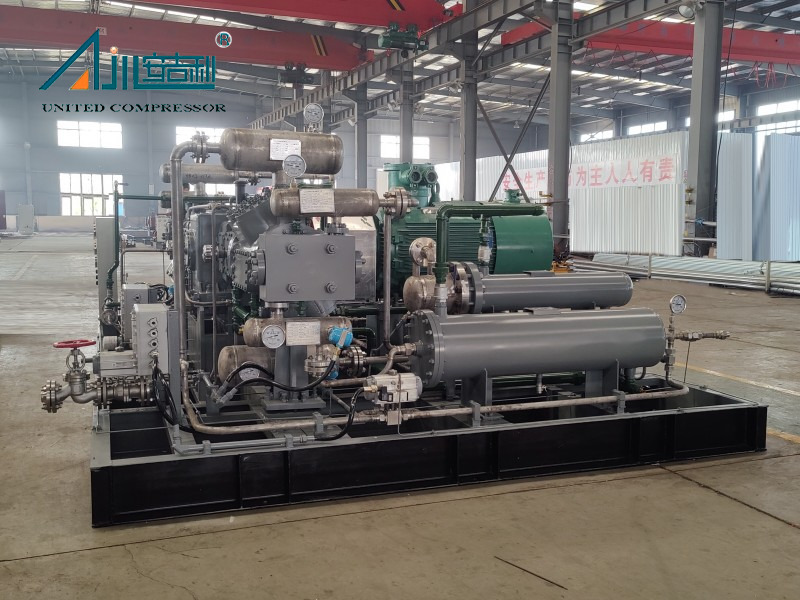
Footprint and installation expenses also heavily impact financial planning. Custom-built site installations incur massive engineering and assembly fees. Modular, skid-mounted, or containerized systems solve this problem. These "plug-and-play" units arrive pre-tested. They dramatically reduce on-site assembly. This approach accelerates deployment and minimizes unpredictable construction costs.
You must choose an architecture that aligns with your specific purity and flow requirements. Three primary technologies dominate the market today. Each presents distinct advantages and specific limitations.
Diaphragm technology isolates the gas from the mechanical drive. A flexible metal membrane physically separates hydrogen from hydraulic fluids.
Strengths: The hermetic seal guarantees zero oil contamination. This makes it ideal for ISO 14687 compliance. Diaphragm units easily handle ultra-high discharge pressures exceeding 1,000 bar.
Limitations: They provide lower volumetric flow rates compared to piston models. The metal diaphragms require precise, scheduled maintenance to prevent fatigue failures.
Piston designs use a traditional cylinder and piston mechanism. They move massive volumes of gas quickly.
Strengths: These units offer exceptionally high mass flow capabilities. They benefit from a well-established, global supply chain for parts and service.
Limitations: Maintenance expenses remain high. Valves and piston rings often account for about 65% of your maintenance spend. Piston systems require robust oil-free designs. Otherwise, they need complex filtration to prevent gas contamination.
Hydraulic models use a liquid column to compress the gas. This design eliminates many traditional mechanical linkages.
Strengths: They feature fewer moving parts touching the gas. This creates smooth operation with minimal pressure pulsation. They are also highly scalable for modular upgrades.
Limitations: The internal structure can be complex. Strict hydraulic fluid management is required. You must ensure zero cross-contamination occurs between the drive fluid and the hydrogen stream.
Architecture | Purity Guarantee | Flow Rate Capacity | Primary Maintenance Focus |
|---|---|---|---|
Diaphragm | Excellent (Hermetic) | Low to Medium | Membrane fatigue |
Piston | Moderate (Requires filters) | Very High | Valves and rings |
Liquid-Driven | High (Oil-free design) | Medium to High | Fluid containment |
Raw specifications mean little without context. Procurement teams must map technical parameters directly to operational goals. Carefully review these three core parameters.
Discharge Pressure Range: You must map station types to required compressor outputs. Dispensing pressure is not the same as storage pressure. Heavy-duty vehicles dispensing at 350 bar require approximately 520 bar of internal storage. Light-duty passenger vehicles dispensing at 700 bar require storage banks holding 1,000+ bar. The compressor must reach these higher thresholds to overcome line losses.
Mass Flow Rate Requirements: Define your capacity realistically. Small commercial or pilot stations typically need 100 to 250 kg per day. Large transit fleet hubs demand 400 to 1,000+ kg per day. Heavy-duty truck applications require massive instantaneous flow rates. Your system must exceed 120 grams per second to fill large tanks quickly.
Dynamic Load Handling: Evaluate the system’s ability to handle frequent start-stop cycles. Public retail stations experience unpredictable traffic. Poorly specified systems accelerate component fatigue under dynamic loads. This remains a common failure point for early adopters. Look for robust cooling loops and smart pressure-balancing features.
Summary chart: Target vehicle type versus required system pressure | ||
Vehicle Type | Dispenser Target | Required Compressor Output |
|---|---|---|
Buses / Heavy Trucks | 350 bar | ~ 520 bar |
Passenger Cars (FCEV) | 700 bar | 1,000+ bar |
Many operators assume hydrogen behaves like common industrial gases. This assumption leads to catastrophic equipment failures. Hydrogen possesses a unique molecular profile. It demands entirely different engineering tolerances.
First, consider material compatibility and embrittlement. Standard carbon steels used in traditional gas handling fail under high-pressure hydrogen. The tiny hydrogen molecules permeate the steel matrix. This causes severe embrittlement and eventual fracturing. Specialized 300-series stainless steels, such as SS 316L, are mandatory to ensure structural integrity.
Second, operators must manage the Joule-Thomson anomaly. Most gases cool down when they expand. Hydrogen does the exact opposite. It heats up rapidly upon expansion. This reverse Joule-Thomson effect demands aggressive thermal management. You must install aggressive pre-cooling chillers to drop gas temperatures to -40°C prior to the dispenser. This entirely changes the thermal load requirements at the compressor stage.
We must clarify operational differences among gas handling machines. A Hydrogen Compressor requires vastly tighter engineering tolerances than a CNG Compressor or a Natural Gas Compressor. Hydrogen's incredibly low molecular weight creates a high propensity for microscopic leakage. Similarly, while a BOG Compressor (Boil-Off Gas) or an LPG Compressor primarily manages phase changes and cryogenic temperatures, high-pressure HRS hydrogen compression is different. It remains singularly focused on generating extreme mechanical force while preserving absolute gas purity.
Standalone performance data will not guarantee station success. The equipment must integrate flawlessly with your site's broader infrastructure. Integration failures cause the most unplanned downtime.
You must address the extreme variability of upstream supply. Pipeline supply provides a consistent 50 to 80 bar. However, tube-trailer delivery acts differently. Pressure steadily depletes from 300 bar down to 30 bar as the trailer empties. On-site electrolyzers often output a steady, low 30 bar. The compressor must seamlessly adapt to these fluctuating inlet pressures. A dropping inlet pressure increases the compression ratio. This significantly increases energy consumption and lengthens fill times.
Hydrogen is highly flammable. Safety compliance cannot be an afterthought. Detail requirements for real-time leak detection in your procurement documents. For example, mandate diaphragm rupture monitoring systems. The site must maintain ATEX/DSEAR explosion-proof compliance. Implement automated over-pressure venting to protect downstream components from sudden pressure spikes.
Digital integration optimizes your daily operations. You need integration with overarching Fuel Management Systems (FMS). Smart controls allow overarching site energy management. For instance, intelligent software can optimize compression cycles during off-peak electricity hours. This lowers your utility bills. It also ensures tanks are full before peak fleet arrival times.
Purchasing high-pressure equipment is complex. Follow a structured framework to narrow down your options. This prevents costly mistakes and misaligned expectations.
Differentiate your operational model clearly. Are you serving a closed-loop transit fleet? These fleets have predictable, scheduled fills. You can plan compression cycles easily. Alternatively, are you running a public retail station? Retail stations face random, high-peak fills. Retail usage requires high storage capacity and rapid recovery times. Your use case dictates your technical needs.
Challenge the assumption that every station needs continuous back-to-back fast-fill capability from day one. Full SAE J2601 compliance for heavy continuous usage requires massive cooling and compression power. Pilot projects often over-specify these elements. A phased, modular upgrade path prevents stranded capital. Buy what you need today. Add parallel units as fleet demand scales.
Look beyond glossy brochures. Request hard data on MTBF for critical wear parts like valves and rings. Analyze energy consumption per kilogram of hydrogen compressed. Most importantly, verify the availability of local service networks. Rapid local response minimizes unplanned downtime. A cheap machine becomes highly expensive if you wait weeks for replacement parts.
Selecting a hydrogen compressor requires a careful balance of thermodynamic reality and commercial viability. This equipment serves as the heartbeat of your refueling station. If it fails, revenue stops instantly.
Prioritize modularity. Build capacity alongside actual fleet growth to protect your initial capital.
Demand proven purity guarantees. Oil contamination destroys fuel cells and damages user trust.
Focus on vendor transparency. Clear maintenance schedules matter more than raw, uncontextualized performance specs.
Prepare for site integration early. Align your software, cooling, and inlet supply configurations before final installation.
Make data-driven decisions based on your specific use case. Right-sized, highly reliable compression technology ensures long-term station profitability and uninterrupted fleet operations.
A: Hydrogen compression requires specialized material science, such as 316L stainless steel, to prevent hydrogen embrittlement. It demands exceptionally tight machining tolerances to contain the universe's smallest molecule and prevent leaks. Furthermore, hydrogen dispensing requires extreme 1,000-bar output pressures, far exceeding standard CNG limits.
A: PEM fuel cell vehicles require 99.97% purity, adhering to the ISO 14687 Grade D standard. Even microscopic oil or moisture contamination permanently destroys the fuel cell catalyst. This strict requirement makes oil-free or hermetically sealed compression technologies mandatory.
A: Yes. Operators highly benefit from modular skid designs. These "plug-and-play" architectures allow you to add extra compression stages or parallel units as fleet demand scales. This prevents over-investing in massive capacity during early pilot phases.
A: When inlet pressure drops—such as when a tube-trailer empties from 300 bar down to 30 bar—the compression ratio drastically increases. This higher ratio forces the machine to work harder. It increases energy consumption per kilogram and significantly lengthens vehicle fill times.


