


Views: 0 Author: Site Editor Publish Time: 2026-06-03 Origin: Site


Natural gas compression accounts for nearly 50% of total operational energy consumption in gas operations. Selecting the wrong system drains corporate resources rapidly. It directly impacts your bottom line and facility safety. Many professionals confuse natural-gas-driven air compressors with true Natural Gas Compressor units. We must clarify this critical distinction. True gas compressors handle the volatile hydrocarbon medium directly. They require specialized seals, metallurgical choices, and safety protocols. If you choose an incorrect unit, you face elevated operational expenses. You will also encounter premature mechanical failures and severe regulatory compliance risks. This article provides an evidence-based breakdown of industrial compression technologies. We explore core engineering parameters and lifecycle maintenance realities. You will discover practical strategies to guide your capital expenditure planning. We strip away generic marketing claims to reveal what truly works in the field.
Reciprocating compressors offer the highest pressure ratios but require rigorous maintenance due to internal wear.
Oil-flooded screw compressors handle wet gas and suction pressure variations (>5%) better but have a 6–8% lower thermodynamic efficiency compared to reciprocating units.
Centrifugal compressors dominate high-volume midstream/LNG applications but lack the turndown flexibility of positive displacement machines.
Modern compliance requires prioritizing emissions mitigation—specifically transitioning to dry seals and predictive maintenance for rod packing.
Understanding mechanical architectures helps you avoid costly misapplications. You must align the machine type to your specific field scenario. We break down the mechanics, best-fit scenarios, and inherent engineering limitations below.
Reciprocating systems rely on multi-stage piston compression. A crankshaft drives pistons back and forth inside robust cylinders. Standard single-stage compression ratios are typically capped around 3:1. Engineers enforce this limit to keep discharge temperatures below 275–300°F. Excessive heat causes valve failure and degrades internal lubrication.
These units excel in upstream wellhead lifting and high-pressure gathering networks. High-psi CNG Compressor stations almost exclusively utilize multi-stage reciprocating machines. They handle dense natural gas effectively.
However, reciprocating compressors present significant trade-offs. They provide high volumetric efficiency and infinite pressure capabilities, sometimes exceeding 10,000 psig. Yet, they remain highly sensitive to solid or liquid contaminants. Liquid slugs can cause catastrophic cylinder damage.
Rotary screw compressors operate via twin-rotor meshing. Two helical rotors interlock to compress incoming gas. Oil injection serves three critical functions. It cools the gas, seals the rotor clearances, and lubricates the bearings. Operators can utilize slide valves for stepless turndown. This allows operation at less than 20% capacity without needing a Variable Frequency Drive (VFD).
These machines fit perfectly in Vapor Recovery Units (VRU). They also dominate wet or dirty gas gathering operations. Facilities frequently deploy them as a low-pressure LPG Compressor or a reliable BOG Compressor (Boil-Off Gas) system. In these specific applications, liquid carryover would destroy standard pistons.
The primary trade-off involves pressure limitations. Single-stage discharge pressure rarely exceeds 300 psig. Additionally, efficiency drops significantly when operating far from the optimal design point.
Centrifugal compressors use integrally geared or single-shaft aerodynamic compression. High-speed impellers transfer kinetic energy to the gas molecules. Diffusers then convert this velocity into static pressure. They easily achieve massive flow rates up to 100,000 actual cubic feet per minute (acfm). However, single-stage pressure ratios remain low, typically between 1.6 and 2.3.
These dynamic machines dominate continuous midstream pipelines. You will also find them powering large-scale LNG processing plants.
Dynamic compressors possess narrow operating windows. They are extremely vulnerable to a destructive phenomenon called "surge" at low flows. You must install complex anti-surge control loops. Recycle valves are mandatory to protect the impellers from catastrophic mechanical failure.
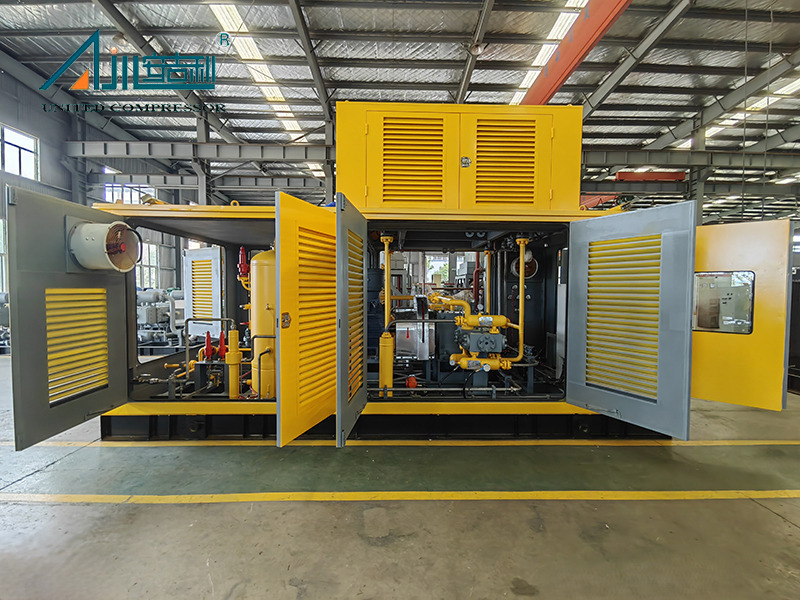
Successful procurement moves beyond basic catalog specifications. You must base your selection on actual process simulation criteria. Real-world gas streams rarely match perfect textbook conditions.
Evaluating suction pressure stability is paramount. Upstream gathering pressures frequently fluctuate. If suction varies significantly, rotary screw units resist "washout" better than reciprocating units. Washout occurs when liquid fractions condense inside the chamber.
You must also factor in strict intercooling requirements. Gas temperatures rise roughly 7–8°F for every 100 psi of compression. Unchecked heat destroys internal components. Robust aftercoolers and scrubbers are mandatory for multi-stage systems. Scrubbers remove liquids that condense between cooling stages.
Common Mistakes in Sizing:
Ignoring seasonal temperature variations at the compressor inlet.
Failing to account for pressure drops across suction scrubbers.
Overestimating the continuous baseline flow rate of a depleting gas well.
Gas density directly impacts aerodynamic efficiency. Molecular weight variations heavily alter centrifugal compressor performance. Lighter gases generate less head pressure per compression stage.
Modern decarbonization trends shift the operational landscape. Legacy natural gas grids are now injecting hydrogen blends. Evaluating a Hydrogen Compressor requires entirely new calculations. You must address severe metal embrittlement risks. Hydrogen features ultra-low molecular weights, making it incredibly difficult to seal. You will face far stricter leak tolerances compared to standard methane applications.
Table 1: Impact of Gas Composition on Compression Technologies | |||
Gas Characteristic | Reciprocating Impact | Rotary Screw Impact | Centrifugal Impact |
|---|---|---|---|
High Moisture / Wet Gas | High Risk (Liquid locking) | Excellent (Oil-flooded protection) | Moderate Risk (Blade erosion) |
Low Molecular Weight (e.g., Hydrogen) | Excellent (Volume driven) | Good (Needs specialized seals) | Poor (Insufficient head generation) |
High H2S (Sour Gas) | Requires specialized valves | Causes oil degradation | Requires severe metallurgy |
Evaluating long-term operational realities requires bypassing vendor marketing. Equipment longevity heavily depends on your maintenance philosophy and local regulatory pressures.
Environmental compliance fundamentally shapes equipment selection today. Federal and corporate ESG targets penalize fugitive methane emissions heavily.
For reciprocating machines, rod packing wear represents the primary leakage source. Friction degrades the packing rings over time. Gas escapes along the piston rod into the atmosphere. Upgrading packing rings frequently is mandatory. Installing active vapor recovery systems has become a standard mitigation technique.
Centrifugal compressors face different challenges. Wet seals absorb and outgas massive amounts of methane during fluid regeneration. Upgrading to dry gas seals eliminates this issue. Dry seals utilize hydrodynamic, non-contacting mechanisms. This represents a high-CapEx, high-ROI retrofit for corporate ESG targets.
Operators are moving away from traditional OEM calendar recommendations. Relying on fixed maintenance intervals wastes money and misses sudden failures. Condition-based monitoring offers a superior approach.
Implementing Industrial Internet of Things (IIoT) sensors protects your assets. You should track the following metrics:
Vibration Analysis: Detects bearing wear and rotor imbalance before they escalate.
Oil Spectrometry: Identifies microscopic metal shavings, indicating abnormal internal friction.
Thermal Imaging: Spots localized hotspots on cylinder valves, pointing to imminent failure.
Acoustic Emission: Listens for high-frequency leaks across compressor seals.
These predictive methods prevent catastrophic cylinder or bearing failures.
Facility managers must plan for strict noise mitigation. Federal Energy Regulatory Commission (FERC) guidelines are strict. They limit noise in adjacent sensitive areas to 55 dBA Ldn. Noise abatement enclosures represent a significant capital expense.
You must also accommodate distinct spatial needs. Reciprocating units require heavy pulsation dampeners. You must pour massive concrete foundations to counter severe vibration. In contrast, rotary screw packages operate far smoother. They demand significantly less structural foundation support.
We present a strict "If-Then" framework. This logic helps engineers and procurement teams finalize their specifications without bias.
Highest Efficiency + High Pressure: Reciprocating
Wet Gas + High Fluctuation: Rotary Screw
Massive Volume + Base-Load: Centrifugal
Fuel and energy efficiency serve as your overriding metric. You can expect a solid 6-8% thermodynamic advantage over screw types.
The unit will run at steady-state design points over 90% of the time.
Your discharge pressure requirements comfortably exceed 350 psig.
Your process inlet conditions fluctuate widely. Suction pressure varies by more than 5%.
The gas stream remains "wet" or is highly prone to liquid dropping out during compression.
Initial CapEx and package simplicity prioritize over absolute thermodynamic efficiency.
You handle uninterrupted, base-load pipeline transmission requiring massive horsepower (>5000 HP).
Your facility demands 100% oil-free gas delivery.
You need an aerodynamic process without internal mechanical friction wear.
No single compressor type solves all upstream, midstream, or downstream challenges. Procurement teams must balance initial CapEx against rigorous process simulation realities. You must respect surge limits and operating temperatures. You also need to plan for long-term operational hurdles, such as emissions fines and packing replacement downtime.
To ensure project success, take the following next steps:
Consult closely with process control engineers early in the design phase.
Run specific software simulations (like HYSYS) to map gas behavior.
Avoid relying purely on generalized OEM sizing charts, which ignore site-specific variables.
Audit your current facility for fugitive emissions to inform upgrade decisions.
By applying these principles, you protect your infrastructure and ensure optimal gas flow under demanding conditions.
A: Reciprocating units generally offer 6-8% better thermodynamic efficiency. However, this performance gap closes quickly if the suction pressure varies significantly off-design. Reciprocating machines excel in steady states, while screw compressors handle fluctuations with less efficiency penalty.
A: Intercoolers drop gas temperatures below 300°F between individual compression stages. This prevents catastrophic valve failure and stops lubricating oils from carbonizing. Cooling also increases gas density for the next stage and allows necessary condensate separation.
A: Operators control surge through automated anti-surge valves. These specialized valves quickly recycle high-pressure discharge gas back into the suction line. This action artificially maintains flow rates when the process drops below the compressor's aerodynamic minimum threshold.


