


Views: 0 Author: Site Editor Publish Time: 2026-06-05 Origin: Site


Efficiently managing Boil-Off Gas (BOG) in LNG terminals presents a formidable operational challenge. Facilities must maintain exact tank pressures. They must also recover valuable vaporized product. Terminals strictly avoid wasteful flaring or venting to meet environmental regulations. Selecting the appropriate compression system directly influences terminal profitability. It also affects power consumption and overall facility safety. A mismatched unit can trigger escalating maintenance demands. You might face costly unexpected downtime.
This guide offers a comprehensive technical evaluation framework. We empower procurement engineers and facility managers to confidently shortlist systems. You can systematically evaluate and specify optimal compression equipment. You will learn the critical differences between compressor types. We cover core safety standards and practical testing requirements. This knowledge ensures safe, continuous, and efficient terminal operations.
BOG compressors must continuously handle cryogenic temperatures (down to -160°C) and variable flow rates without compromising seal integrity or mechanical reliability.
The choice between reciprocating and centrifugal systems depends heavily on terminal capacity, required discharge pressure, and turndown flexibility.
Strict adherence to industry standards (API 618/617, API 614, ATEX) is non-negotiable for safety and regulatory compliance.
Handling boil-off gas requires highly specialized equipment. A robust BOG Compressor manages natural gas in a vaporized, low-temperature state. We must understand the underlying thermodynamics. Compressing ultra-cold gas demands meticulous engineering. Gas density increases significantly at cryogenic temperatures. This affects the required motor power and structural integrity.
Compressors must compress gas starting from exceptionally cold suction conditions. Temperatures frequently drop to -160°C. Standard compression principles still apply. However, the thermodynamic behavior of the gas changes. The high density of cold gas means smaller physical displacement achieves higher mass flow. Engineers must account for these density shifts. They must calculate precise specific volume parameters. This prevents motor overloading as temperatures fluctuate during operation.
Terminal operations rarely follow a steady state. You will experience massive dynamic load variability. BOG generation spikes dramatically during ship unloading operations. Large volumes of liquid enter the tanks. This displaces vapor rapidly. Conversely, gas generation drops significantly during holding modes. This reality makes dynamic simulation absolutely necessary during capacity planning. You cannot rely on static peak-load assumptions. Facilities need systems capable of aggressive load shedding.
The "cold section" represents the most demanding engineering aspect. Compressor cylinders and piping face extreme thermal contraction. Carbon steel becomes dangerously brittle at these temperatures. Manufacturers must utilize cryogenic materials. They typically use 304L or 316L stainless steel alloys. Specialized sealing poses another major hurdle. Conventional lubricating oils freeze solid instantly. Engineers deploy specialized non-lubricated PTFE blend seals. They also implement elongated distance pieces. These protect the warm crankcase from the freezing cylinders. Proper nitrogen purging prevents moisture ingress and dangerous gas contamination.
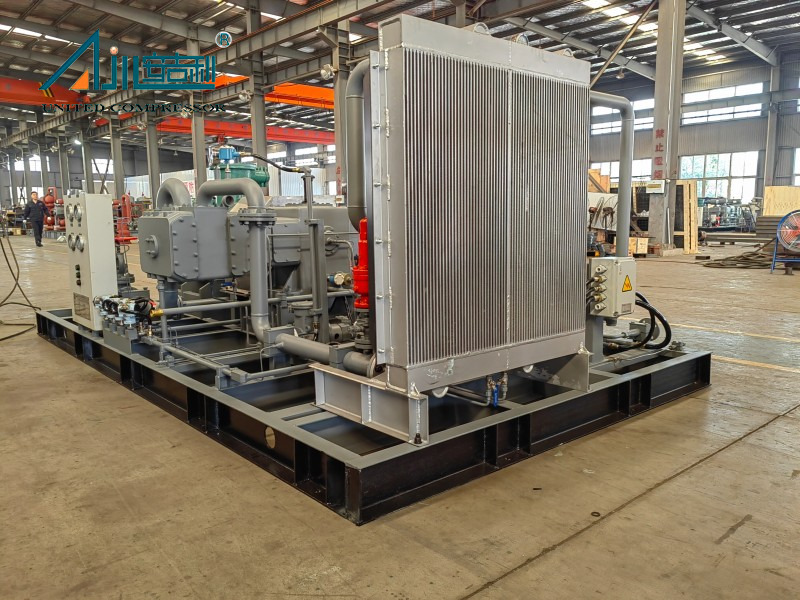
Procurement teams usually choose between two primary architectures. They evaluate reciprocating systems against centrifugal systems. Both designs offer distinct operational advantages. Both carry inherent mechanical limitations.
Reciprocating systems utilize pistons driven by a crankshaft. They rely on positive displacement principles.
Best for: These units excel in high-pressure ratio applications. They fit perfectly into smaller to medium capacity terminals. They offer exceptional turndown flexibility. Operators usually rely on variable-frequency control systems. In typical applications, variable-frequency regulation can cover 0% to 100%, helping the compressor match variable boil-off rates more precisely.
Limitations: They require a larger physical footprint. They generate higher vibration profiles during operation. You must invest in robust foundation engineering. Concrete mass blocks absorb these dynamic forces. They also have more moving parts. This typically increases the frequency of minor maintenance interventions.
Centrifugal systems use rapidly rotating impellers. They impart kinetic energy to the gas.
Best for: These machines dominate base-load LNG terminals. They handle massive volume flows effortlessly. They support continuous operation beautifully. They require significantly smaller footprint requirements. They generate minimal vibration compared to piston units.
Limitations: Centrifugal units possess narrower operating envelopes. They struggle with massive turndown requirements. They are highly susceptible to aerodynamic surging. This occurs if gas molecular weight or flow drops significantly. You often need complex bypass loops to prevent surge damage.
Feature/Metric | Reciprocating Compressor | Centrifugal Compressor |
|---|---|---|
Volume Capacity | Small to Medium | Massive / Base-load |
Pressure Ratio | Very High | Moderate to High |
Turndown Flexibility | Excellent with variable-frequency control (0-100%) | Limited (Prone to surge) |
Physical Footprint | Large | Compact |
Vibration Profile | High (Requires deep foundation) | Low |
Equipment architecture for BOG systems shares fundamental DNA with other gas handling units. You can observe similarities with a standard Natural Gas Compressor. You will also see overlaps with a heavy-duty LPG Compressor. Evaluating a manufacturer's broader portfolio proves highly beneficial. A vendor building diverse gas systems demonstrates deep engineering depth. Their cross-industry experience often translates to more resilient component designs.
Moving from basic specifications to actual procurement requires strict evaluation criteria. You must translate technical features into operational outcomes. We recommend prioritizing the following elements during your vendor assessment.
Turndown Capability vs. Efficiency: Assess how well the compressor adjusts to partial loads. Terminals rarely run at 100% capacity continuously. Look for systems that handle 25% to 100% load variations efficiently. Avoid units that rely entirely on gas bypass valves. Bypassing wastes massive amounts of energy. Prioritize variable-frequency regulation where the project design allows it. In typical applications, variable-frequency control can regulate output from 0% to 100%, helping reduce energy waste during low-flow operation.
Mean Time Between Failures (MTBF): Evaluate overall system reliability. Frame your evaluation around operational uptime. Analyze consumable part lifespans carefully. Look at compressor valves, rider rings, and piston packings. Non-lubricated environments wear components faster. Request verifiable MTBF data from manufacturers. Understand long-term energy consumption curves. Minor efficiency drops translate to massive power bills over a decade.
Footprint and Modularization: Assess the viability of skid-mounted delivery. Pre-piped and pre-wired units offer plug-and-play installation. They minimize on-site construction risks. They drastically reduce site engineering costs. Compare this against stick-built installations. Stick-built designs require extensive field welding. They prolong commissioning schedules significantly. Modular units undergo comprehensive factory testing before shipment.
Handling explosive, cryogenic gases demands uncompromising safety protocols. Regulatory compliance is non-negotiable. Procurement teams must verify adherence to strict global standards.
Electrical components operate in explosive gas atmospheres. BOG leaks can ignite instantly. You must define the necessity of hazardous area certifications. European projects require ATEX compliance. International projects rely on IECEx standards. North American facilities demand NEC compliance. Motors, instruments, and junction boxes must meet specific Zone 1 or Zone 2 classifications. They must feature intrinsically safe or flameproof enclosures.
Mitigating risk during installation saves millions in delayed commissioning. You must demand rigorous testing protocols. You also need an eye on future operational expansions.
Never bypass comprehensive Factory Acceptance Testing. You should require mechanical run tests at the manufacturer’s facility. String testing is critical. A string test connects the actual compressor, project motor, and auxiliary systems together. It proves integration before shipment. Cryogenic testing adds another layer of security. Vendors flow liquid nitrogen to cool the cold section. They then run the compressor. This reveals thermal contraction issues immediately. It mitigates massive site integration risks.
Pulsation causes severe pipe fatigue. Reciprocating units generate intense pressure waves. Highlight the engineering requirement for advanced acoustic studies. Demand an API 618 Design Approach 3 analysis. This digital simulation models the interaction between compressor pulses and site piping. Engineers use it to design exact pulsation dampeners. They place orifice plates strategically. This eliminates destructive resonance frequencies before steel is ever cut.
The energy sector is evolving rapidly. Facilities explore multi-gas capabilities. Evaluate manufacturers proven in building advanced Hydrogen Compressor systems. Look at their high-pressure CNG Compressor portfolios. These applications demand superior metallurgical expertise. They require extreme high-pressure sealing technologies. Vendors mastering these volatile gases bring superior engineering practices to your BOG project. This reduces risk for terminals planning future expansions. It future-proofs your initial capital investment.
Selecting a boil-off gas compression system requires meticulous technical scrutiny. You must prioritize manufacturers providing transparent thermodynamic modeling. They must offer verifiable API compliance. They must demonstrate proven lifecycle support capabilities. You need systems balancing turndown flexibility with long-term mechanical reliability.
Take actionable next steps immediately. Define your specific minimum and maximum flow rates accurately. Map out required pressure differentials. Measure your exact physical footprint constraints. Compile this specific data before issuing a Request for Quotation (RFQ). Vague specifications lead to mismatched equipment.
Do not hesitate to leverage expert engineering support. Contact technical sales teams for a project-specific feasibility review. Request a customized performance curve simulation based on your dynamic unloading scenarios. Early technical alignment guarantees long-term operational success.
A: Reciprocating systems offer exceptional flexibility. With typical variable-frequency control, capacity regulation can usually cover 0% to 100%. This helps reduce reliance on inefficient gas bypass loops. The compressor adjusts operating output to match variable boil-off rates more precisely. You save significant energy during low-flow holding modes.
A: Standard pipeline compressors handle ambient-temperature gas. BOG units process vaporized gas at cryogenic temperatures down to -160°C. They require specialized non-lubricated cylinder designs. Standard oil lubrication would freeze instantly. They also use distinct sealing materials like PTFE blends. Engineers must specify specific stainless steel alloys to prevent brittle fractures.
A: Valve lifespans vary based on operational continuousness and gas purity. Industry benchmarks suggest realistic maintenance intervals between 8,000 and 16,000 hours. High-quality non-lubricated valves typically operate reliably for one to two years. Strict adherence to proper nitrogen purging protocols prevents moisture ingress. This extends the service life of critical internal components.
A: Yes, they routinely manage composition changes. However, molecular weight shifts impact systems differently. Centrifugal compressors are highly sensitive. A sudden drop in molecular weight increases the risk of aerodynamic surge. Reciprocating units handle composition variations much better. They rely on positive displacement. This makes them inherently stable during gas quality fluctuations.


